Alison Cooley, ‘OUTER SPACE IS REAL’ at the Akin Vitrine Gallery
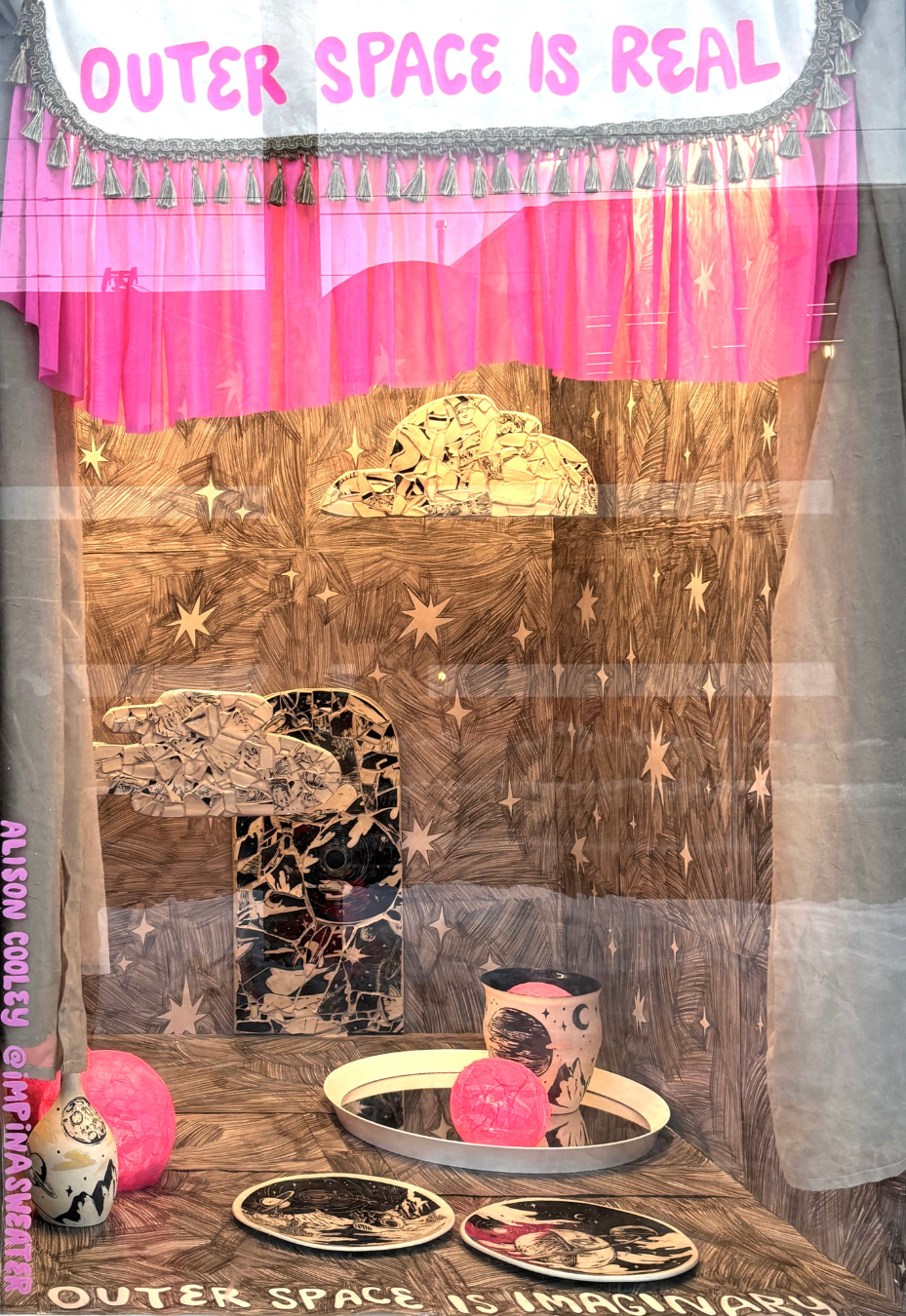
Photo of Alison Cooley’s exhibition, “OUTER SPACE IS REAL” at the Akin Vitrine Gallery
The Akin Vitrine Gallery is excited to announce the opening of a new exhibition, ‘OUTER SPACE IS REAL’ by Akin St Clair studio member Alison Cooley. Viewable from the street 24/7, the Akin Vitrine Gallery is located at 1747 St Clair Ave W. The exhibition runs for all of February and March, so be sure to check it out!
Alison Cooley (@impinasweater) is an artist and artsworker. Her practice includes ceramics and illustration, as well as dabbling in fibre arts, game design, and prop-making. Her vitrine installation, OUTER SPACE IS REAL, is composed of ceramics, mosaics, textile, and paper components and runs from February 1 to March 31. The project plays with ideas about space, the celestial, reality, and imagination, evoking science fiction, early handmade speculations about outer space, and totally made-up ideas about the universe.
We caught up with Alison to learn more about her work and inspirations.
Akin: What are you curious about right now?
Alison Cooley: “I've been taking some bookkeeping courses at Humber College lately. I've worked in the arts for a long time, and realized at a certain point I wanted to devote some energies to formally studying financial processes. It's really been expanding my brain.”
Akin: Tell us a bit about your Vitrine Exhibition (e.g. themes, materials, inspiration)
AC: “I've been working on/with images of space and science fiction for a while now. I'm interested in some of the tensions inherent in working in a really analog, old-fashioned way (ceramics are one of the art forms we have some of the earliest surviving archaeological evidence of) and working with really futuristic imagery. Ceramics are literally made from the earth, and outer space both shares those materials on a very fundamental, we're-all-made-of-star-stuff level, and is the container outside or beyond them.”
My relationship to science fiction imagery is also super nostalgic. I grew up devouring Star Trek TNG and reading Sci Fi and having a very active imagination, and I'm not alone in those things, for sure. There's a funny play between past and future happening within science fiction imagery for a lot of people.
Space is utterly far away from us, unreachable and full of mystery for most of us—and such a huge influence on human spirituality and sense of perspective on ourselves and our world. And at the same time, we are in direct contact with space every day: our sun, our atmosphere, our cycles of day and night make up the rhythms of our lives. My own preoccupation with science fiction and the gnarly images of it humans have made for centuries is where this work came from, but as I've worked with this imagery I've also become more and more interested in how we tell stories about space. This obviously has a huge geopolitical dimension to it, and space has equally been a site for some amazing decolonial storytelling and some absolutely wild nationalist propaganda. It's also often the natural site for imagining utopias and fresh starts and political and social structures outside our own.
This vitrine exhibition is really playful, and I've incorporated a very maximalist set of materials and ideas, because I'm interested in creating a handmade playground for some of these ideas to rub up against each other.”
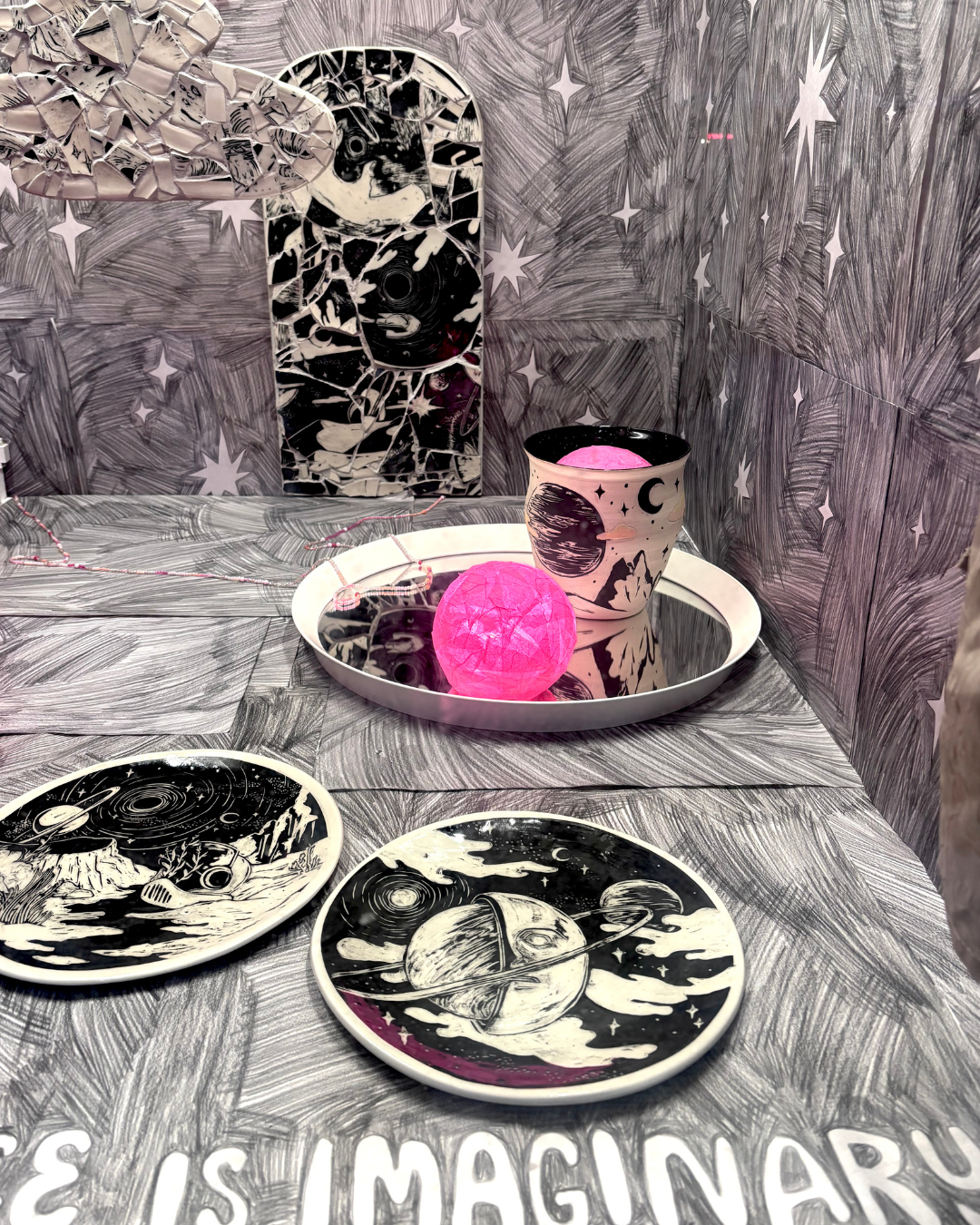
Detail of Alison Cooley’s exhibition, “OUTER SPACE IS REAL” at the Akin Vitrine Gallery
Akin: Do you have studio routines or rituals? What gets you in a creative mood?
AC: “I have a lot of them! I change into my studio clothes (which is a safety thing to manage dust as well as a thing that demarcates the space between inside and outside), I make myself a hot drink, and usually I watch or listen to something I can spend hours on—lately that's been a steady stream of audiobooks. Richard Osman's Thursday Murder Club, Waubgesig Rice's Moon of Crusted Snow/Turning Leaves, and Ada Palmer's Terra Ignota books are the ones that have been keeping me occupied lately. And watching all the previous seasons of Survivor in the lead-up to this year's 50th season.
I have an elaborate set of tricks I use to get myself to do pretty much everything: with timers, a weekly hand-written schedule, rules about how long I have to force myself to do something (this is a trick to start on something and then get sucked in to actually finishing it), rewards, etc. I am pretty regimented about my studio time because I also have other jobs, and it's a blessing to carve out the time to be an artist.”
Akin: What inspires you? Why?
AC: “I've been working with Bawaadan Collective (an Indigenous-run film and media production house out of Hamilton) for the last 2 years or so, supporting on various projects. Last year I got the chance to do some prop-building for a few projects with them—including for an underwater photo shoot—and it has really expanded how I think about working with different materials, and how I think about staging compositions. That's really inspired how I've thought about this installation: turning my attention to how I can stage it and use the space in a way that feels theatrical or performative.
I also am constantly inspired by working with other artists, talking about ideas and problem-solving creative dilemmas.”
Akin: What does your Akin studio mean to you? What brought you to Akin?
AC: “I came to Akin in 2022 because I was at a transitional point in my practice: I had taken pottery classes and knew I needed to spend some time developing my own work in order to take it to the next level. I also couldn't really imagine (as someone who had jumped from a salaried job into freelancing) how I could manage (creatively or financially) to continue to take classes and get just a couple hours of studio time a week. I had a lot of big ideas and wanted to make more stuff than I figured I could manage with a shared membership at a pottery studio either—with limited hours of access and limited shelf space, firing time, etc.
Akin was a really perfect answer to me, and the opportunity to work at my own hours and whatever volume of creative output I had at the moment was so enticing. The community around Akin is also pretty amazing: being able to talk about ideas and problems with other artists, work with Lili to fire work in her kilns, and get to casually observe how other folks structure their practices and their lives is extremely valuable.”
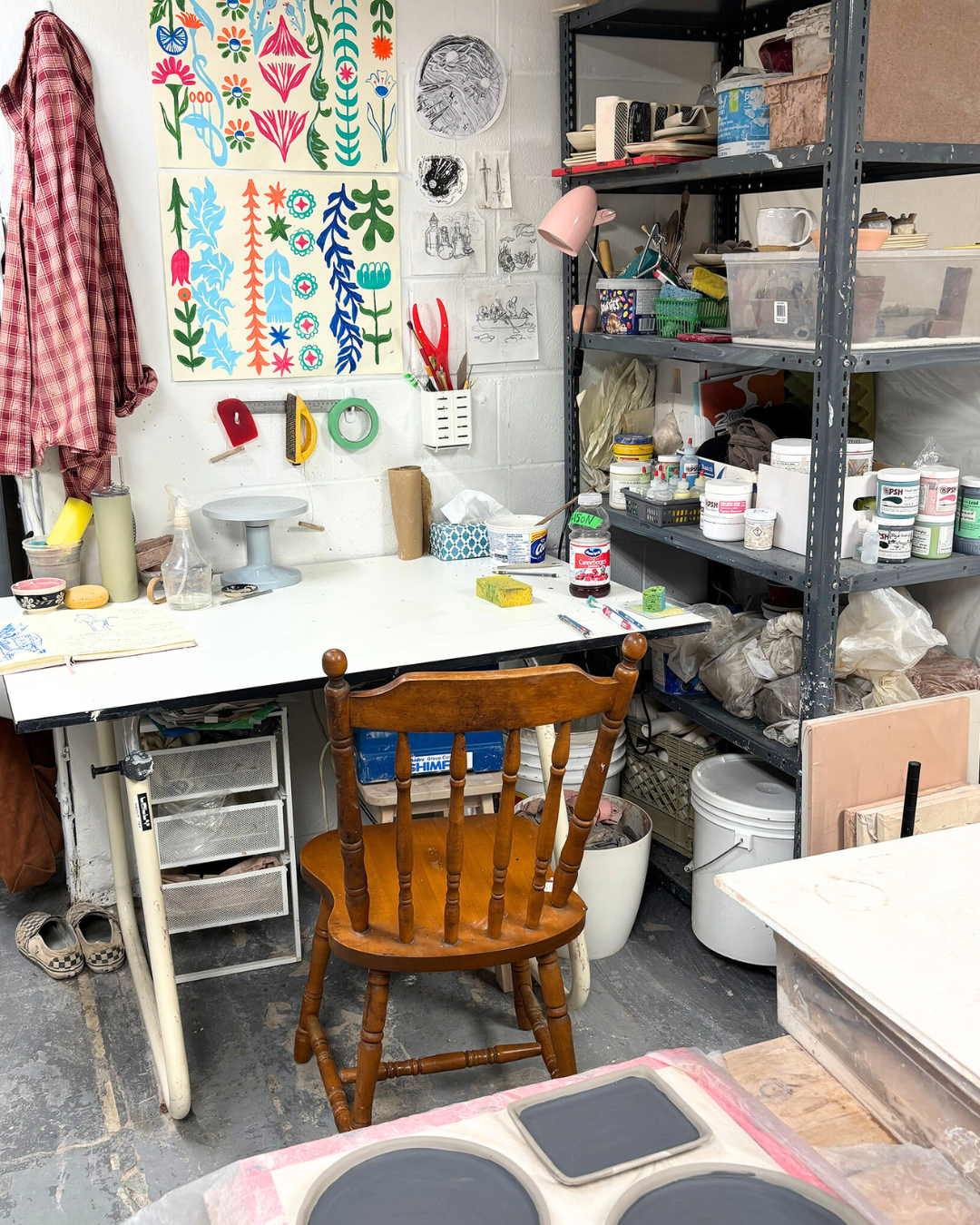
Alison Cooley’s studio at Akin St Clair
Akin: What advice would you tell your younger self about creating art? What have you learned?
AC: “I was given a lot of advice as a young artist about the viability of a career in the arts: how it would be hard, how you had to hustle, how you would have to compete with your peers, etc. I also believed that it would be worth it to do those things because I really loved my work.
For me, this advice was very much a part of an all-or-nothing approach: you either were a real professional artist (or curator, arts administrator, whatever) who had burned yourself out to be there, or you were just a hobbyist and your work wasn't that serious. It was impossible for me to see a middle road as a young person: you can get a non-art job and protect your peace, grow your practice slow, make sure you still feel joyful or propelled by what you make, work with people you trust and share resources, weather the hard times, take pauses, come back to making stuff in a new way, have an experimental mindset about both your work and your life.”
Learn more about Alison Cooley’s work here:
Instagram: @impinasweater
Tiktok: @impinasweater
Alison’s ceramics are also carried at Savile Studio & Market on Roncesvalles.
Akin Vitrine / Akin St Clair: 1747 St Clair Ave W