ART BUS- DECEMEBER 1, 2013.


Sonny Assu, Silenced: The Burning, 2011. Courtesy of the artist and Equinox Gallery, Vancouver. Photo: Scott Massey, Site Photography.


ARTbus: Exhibition tour to the Justina M. Barnicke Gallery, Blackwood Gallery and Oakville Galleries

Sunday 1 December 2013, 12:00 pm–5:00 pm
Pick-up and drop-off at the Justina M. Barnicke Gallery (Hart House, University of Toronto, 7 Hart House Circle, Toronto)

$10 donation includes admission to all galleries and afternoon refreshments

For reservations, contact artbus@oakvillegalleries.com or 905.844.4402 ext. 27 by Friday 29 November, 4:00pm.

Ride the ARTbus and discover some of the winter's best exhibitions in the GTA!

Our winter ARTbus begins at the Justina M. Barnicke Gallery with a tour of Something More Than a Succession of Notes by executive director/chief curator Barbara Fischer. The ARTbus continues on to the Blackwood Gallery for a tour of Red, Green, Blue ≠ White by curator Johnson Ngo. Finally, at Oakville Galleries participants will visit Sonny Assu: Possession at Centennial Square, and A Noble Line at Oakville Galleries in Gairloch Gardens. For more information, please visit www.oakvillegalleries.com.

In-kind support provided by Trafalgar Brewing Company and Whole Foods Market, Oakville

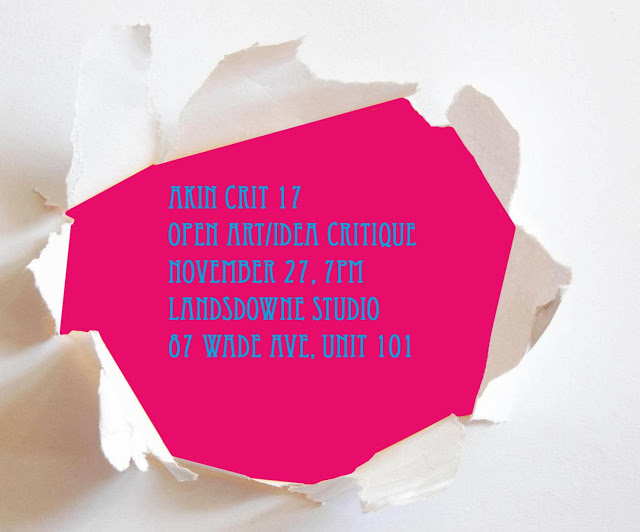
AKIN OPEN STUDIO/ XMAS SALE/ COLOURING BOOK LAUNCH: DEC.7


Join us for a showcase of recent work by members of Akin Collective along with our annual holiday sale and the launch of our first publication, the Akin Colouring Book.


To help get you in the festive cheer there will be some mulled wine, treats and wobbly pops.


Bring friends, family, strangers and your festive game face.

BYOB

December 7, 1:00pm-6:30pm
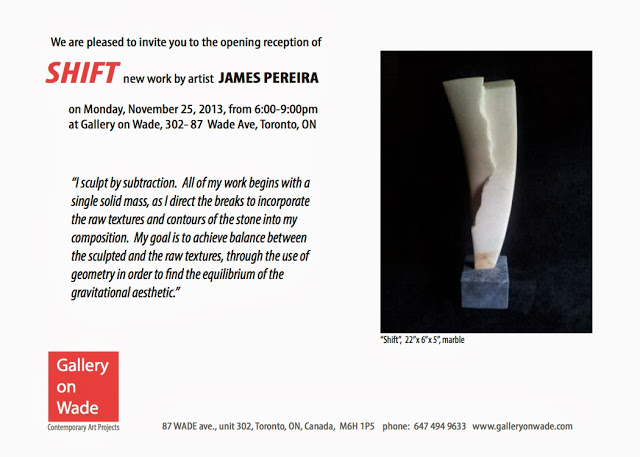
Akin Landsdowne Studio, 87 Wade Avenue, Toronto.

FACEBOOK EVENT IS HERE

AKIN FORGE WORKSHOP SERIES: GAME DESIGN FOR ARTISTS


Twine is a highly adaptable video game making tool that's being taken up by artists and storytellers the world over. Melding indie games, zine culture and a Choose-Your-Own-Adventure format, Twine has been lauded for its' simplicity, flexibility and charm. 

Our facilitator, Daniel Murtha, is a British animator and filmmaker working in Toronto. Learn about this captivating new medium from him in this collaborative workshop for artists, writers, designers and performers. 

ABOUT DAN http://danielmurtha.com
ABOUT TWINE http://twinery.org//
PLAY GAMES http://dl.dropboxusercontent.com/u/87314472/twinehub-play.html
FB INVITE

///////////////////////////////////////////////////////////////////////////////
ABOUT FORGE:

FORGE connections. FUEL your practice. RESHAPE your creative process.

Kicking off this Winter, FORGE will be AKIN Collective’s newest creative incubator for practicing artists and designers. Participants will learn and share skills, discuss, debate, bust creative ruts, stretch their abilities, brainstorm with peers and be challenged to step outside of their practice. Our thematic workshops will provide an opportunity for advanced skill building with a strong emphasis on collaboration and knowledge transfer among members of AKIN’s community and beyond, and will focus on exploring unconventional processes or modes of expression. FORGE new paths in your creative practice.
///////////////////////////////////////////////////////////////////////////////

Akin Collective at OCAD- TOOLBOX

COME VISIT AKIN AT OCAD!


TOOLBOX 2013

 
TOOLBOX is a two-part event including a tradeshow and public lecture.

TOOLBOX TRADESHOW

4th annual celebration of studio education
Thursday November 7, 2013
10 a.m. to 4 p.m.
Great Hall and Main Lobby
Free Admission!
Organized in the style of an industry tradeshow, TOOLBOX Tradeshow is an open house event designed to celebrate fabrication and studio-based education. We've invited vendors, suppliers and friends of the shops and studios to participate by setting up booths to promote their products and services. This event is a valuable opportunity for knowledge and resource exchange with a large audience of OCAD U students, staff, faculty, alumni, as well as members of Toronto’s art and design community. There will also be giveaways, door prizes and ongoing demonstrations in the lobby by our studio technicians, including technicians from the Printmaking Studios, Fabrication Studios, and Material Art & Design Studios. Come visit the Great Hall to learn more about studio resources and equipment available to you!  
Vendors confirmed for TOOLBOX 2013 (more to come!):
If you are a vendor interested in participating, please contact Kim ArmstrongExt. 362 or Emily Gowan Ext. 2268 for more information.

TOOLBOX LECTURE

Safe Studio Practice for Students & Graduates: Talk by Monona Rossol
Thursday November 7, 2013
5 to 7 p.m.
Central Hall (Room 230)
Open to public!
TOOLBOX Lecture will feature a presentation by Monona Rossol. Many young artists and designers learn their skills and craft within an institutional context, where safety is managed by professionals, and significant resources are dedicated to establishing and maintaining the safest possible work environments. However, upon graduating from these institutions, they often must continue to work without these resources. Many young graduates end up setting up their own studios, either individually or collectively, but almost always on a strict budget. Many will work in their own homes   or live in their workplaces. Even though they have received training and education in safe work practices, financial exigencies often trump caution.
Ms. Rossol will deliver a talk aimed at students and graduates making the transition from an institutional setting to a developing professional one. Given limited resources and the pressure of establishing independent practices, Ms. Rossol will identify essential safety issues that new artists and designers should be concerned with for their continued health and sustainability of practice. This will be an exciting and informative lecture followed by an open discussion period.The event takes place in Central Hall on November 7, from 5 to 7 p.m.
This lecture is hosted by Studio Management and Office of Safety & Risk Management at OCAD U. Generously supported by Henry's Canada and Heritage Safety.
Monona Rossol is President/founder of Arts, Crafts and Theater Safety, Inc., a not-for-profit corporation dedicated to providing health and safety services to the arts.  She is a chemist, artist and industrial hygienist. For more information, visit Acts: Monona Rossol.

CALL FOR SUBMISSIONS: TORONTO PEARSON AIRPORT

pic


Toronto Pearson is the starting point for millions of journeys each year, taking people within the province, across the country or to the other side of the globe. For the 2013 juried exhibition, artists are invited to reflect upon their travels. Images may be inspired by an actual place or by the experience of travel. DEADLINEMonday November 4

pic


Toronto Pearson
6135 Silver Dart Dr Mississauga, ON L5P 1B2
(416) 776-9892

MEGA CRITIC VS MEGA GALLERIES


                   Saltz on the Trouble With Mega-Galleries
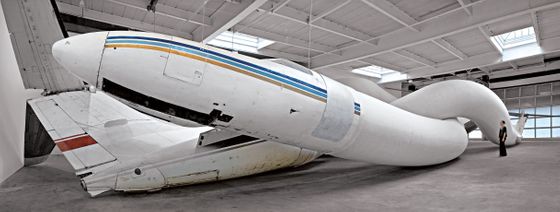
Adel Abdessemed’s Telle Mère tel Fils, at David Zwirner in 2009.
By far the most common topics of discussion and consternation in the art world these days are the four behemoths. Gagosian, Hauser & Wirth, David Zwirner, and Pace are the bull elephants of the field, galleries that galumph everywhere all the time, Hoovering up artists and money and monopolizing attention. With their enormous spaces, multiple branches, well-oiled business models, massive staffs, PR networks, market power, and endless capitalization, they are overwhelmingly present. They take up hundreds of thousands of square feet in New York and much more across the globe. Each started small, and each has transitioned from the complex personal visions and eccentricities of its founders into an enormous corporation. All four stand for success, celebrity, spectacle, supply-side abundance, gall, merchandising, and monomania. Call them ­conquista-galleries. Or Death Stars.
They’re growing, too. Hauser & Wirth opened its second location here in January, in the gigantic former Roxy, and is starting on a great big L.A. space, has hangar-size rooms in Zurich, and will next launch an entire arts center in England, adding to the three galleries it already runs there. David Zwirner—who built big on West 20th Street last season—recently restored a building in London. In March, Larry Gagosian announced the opening of a 22,000-square-foot London trading floor—his third in that city and fourteenth worldwide. The sun now never sets on Gagosian. I know three of the megadealers themselves—Zwirner, Gagosian, and Hauser & Wirth’s Iwan Wirth. (I don’t know Pace’s Arne Glimcher, and I’ve never actually known who Hauser is, now that I think about it.) All three are as smart and passionate about art as anyone I’ve ever met. Each could argue you under a table, with a smile. Each shows great artists. All have done the hardest thing a gallerist can do: discover, rediscover, and nurture important artists.
Yet something happens to people when they sign with the megas. Too often, the artists are brought in at mid-career, and—like 34-year-olds signed by the Yankees—they are poised for a decline. Every show of living artists in these galleries is ushered in like a career retrospective, a quasi coronation, with everything often already sold or spoken for. There’s no space for debate about the merits. Many of these shows are too big by half, filled with dross. No matter. PR staffs crank up; bells and whistles go off; critics give wet kisses and write jargon-filled texts that disguise the fact that what is written and what is written about are often both meaningless, or they take the easy way out and just write screeds. The artist is a brand, and the brand supersedes the art. The scale and pace of these places often turn artists into happy little factories with herds of busy assistants turning out reams of weak work. It’s the new Capitalist Realism.
Artists don’t automatically decline when they join mega-galleries. Some bloom, some don’t, but something always happens. Takashi Murakami’s work didn’t turn into candy-colored blancmanges when he left Marianne Boesky Gallery for Gagosian. He presumably would have gone into overproduction regardless. Being in a gallery with unlimited funds, space, and clout simply looks to have increased his options, sped up his decay, and stunted his vision. This applies to a lot of artists under 50. Ten years ago, the endearingly crafted embroidery paintings and sweet videos of Francesco Vezzoli were bewitching. After joining Gagosian, he went horribly wrong, unleashing his inner terrible artist and creating one of the worst shows seen in these parts for some time. I remember some dark, overconstructed church interior decorated with paintings of movie stars and models who were crying embroidered tears, and another huge room with a banal video. It was epically innocuous, the Godfather: Part III of art shows.
The publicity-loving bad boy Dan Colen is only now recovering from his 2010 misfire at Gagosian that included an upside-down skateboard ramp, a long row of kicked-over motorcycles, and paintings made with chewing gum and confetti. Since leaving Petzel Gallery for Gagosian, Richard Phillips, a great guy, has been producing portraits of Lindsay Lohan and former porn stars, as if he were creating his own corporate brand of Gagosianism tailor-made for the exact clientele who shops at Gagosian. Adel Abdessemed’s Telle Mère tel Fils (Like Mother Like Son), at Zwirner—the big knotted airplanes seen on these pages—was merely a colossal piece of sculptural baloney, a billionaire’s cornball bauble. (By the way, I’ve been mentioning only men because not only are these galleries owned mainly by men—that’s mainly whom they show. Rest assured, there are mediocre women artists in these galleries as well.)
Or consider painter Mark Bradford, who was sustained through painterly ups and downs at Sikkema Jenkins & Co. And I do mean downs: During Bradford’s exhibition a year ago, his dealer, Michael Jenkins, somehow made his way to the gallery through Hurricane Sandy and propped up the paintings on file cabinets, keeping them above the waterline, saving them from destruction, and sacrificing the gallery’s paperwork to do it. It apparently wasn’t enough, though. Bradford has since moved to Hauser & Wirth. 
The megas (like all galleries) say their job is to nurture talent and help artists succeed, but if you look at what they do, it is more like branding: Find a buzzy artist, no matter how iffy, and get his or her name out there. Pace co-owner Marc Glimcher recently told the New York Times about his failed pursuit of a blue-chip artist. “Everybody wanted to take on Julie Mehretu; we all went to her studio … she’s a bona fide, couple-of-artists-in-a-generation-type genius.” I know Mehretu; she was a student of mine. I like her. But she’s no “couple-of-artists-in-a-­generation” artist. Her work is handsome but mediocre. She is, however, an artist who is salable, and that’s why Glimcher declared in anotherTimes story, “We’re all chasing the same artists.” As the artist Rob Pruitt observes, “Most dealers see what’s hot and decide to show that.” By now, these galleries are essentially exploiting the potential of artists who have been carefully nurtured for years by other galleries. And often ruining them.
If any doubt lingers about the potentially pernicious effects joining a mega-gallery can have on a younger artist, look no further than Matthew Day Jackson’s New York debut, up now at Hauser & Wirth (the artist’s third gallery in less than a decade). This dolefully atrocious show looks like a relic from 2004, when Damien Hirst was in the final stage of moving from truculence into blowsy bathos. Supplied with unlimited means and more space than he knows what to do with, Jackson falls flat, going pointlessly huge and painfully obvious. He displays a long wall of anatomical models in vitrines, employs Hirstian titles like Alone in Relationship to the Absurd—a tragic sign that he knows what’s happened to his vision. The painter-critic Walter Robinson recently wrote that work like Jackson’s “lacks any sense of mystery and is a sign that the avant-garde sensibility is now so commonplace, widely known, and understood that it actually approaches the status of kitsch.”
The galleries where artists’ careers are really built from scratch are being forced to expand lest they be overwhelmed or picked clean by the megas. Even the matchless Marian Goodman says that it “seems to be the right time” to open a London branch, adding that she’s “not out to conquer the universe like some of the men.” Several mid-size galleries are said to be contemplating mergers. I hear that Los Angeles’s Blum & Poe has Tokyo and New York branches in the works. Emmanuel Perrotin, who has spaces in Paris and Hong Kong, recently added one on the Upper East Side. He told the Times, “[W]e are driven above all by a fear of losing artists if we don’t develop at their rhythm.” I can’t help thinking that the rhythm he’s talking about is illustrated by a sculpture in his current show: a giant blue metal cube that spits money at viewers.
Mind you, this isn’t a market rant. Even in 1964, happenings guru Allan Kaprow decried, “If the artist was in hell in 1946, now he is in business.” Mega­-galleries do as many good and bad shows of contemporary art as any gallery. I go to and write about some of these. All this has to be taken on a case-by-case basis, without moralizing. Still, mega­-galleries do so many more contemporary shows of so many more artists of a certain ilk in so many places at once that the experience starts to feel preplanned and cynical. Often, in this context, even good work takes on deleterious meanings: hype, hubris, commodity fetishism, hyperefficiency, expeditiousness. The artist Carissa Rodriguez recently compared galleries to “bleached anuses” in porn, meaning (I think) that they’re unnaturally sterile.
Again, none of this is to say that everything the megas do is bad. Over the last several seasons they’ve also been staging more and more museum-level shows of historical material. These are often great exhibitions that, in an era when museum budgets are strained, we wouldn’t otherwise get to see. The John McCracken survey now at Zwirner is outstanding. But we have to ask what kinds of pseudo-museums these institutions are, because in mega-­galleries, quality, quantity, availability, opportunism, and marketability are often interchangeable. One’s never sure whether these are shows of available product, stuff floating around the secondary market, collectors liquidating assets or looking to pump and dump, or the deeply felt personal passion of the dealer. One month the megas show gigantic installations of shiny crap and bric-a-brac. The next month they’re showing Reinhardt, Rauschenberg, or De Kooning.
Don’t blame the dealers or the size of the spaces. These galleries are businesses, doing what businesses do. Any artist who signs with one of these places knows exactly what he or she is doing. Artists always claim to do only what’s creatively best for their work, yet in many cases going with a mega is the opposite of what they need. I imagine freaked-out artists, having made the leap, thinking, What have I done? How do I get out of here? If it weren’t for their marketability, half of these artists wouldn’t get offers from anyone.
An aesthetic crisis looms. To grow so huge, these gallerists have had to increase their overhead and output of energy enormously, while decreasing their artistic complexity, capacity for chaos, and quick and fresh thinking. The megas have reached a dangerous stage where they’re using the same amount of energy that they’re generating. In nature, this break-even moment is called the “compensation point,” the time in a plant’s life when a branch consumes the same amount of energy as it produces. When the compensation point is passed, the plant cuts off growth to the branch, and it dies. It’s time for all of us to do the same. With exceptions for their historical shows, and those few living artists who escape the vision-squishing force of these places, mega-­galleries have reached their compensation points. Said simply, mega-galleries are a system too big not to fail. That, or they’ll rule the Earth for a million years.
*This article originally appeared in the October 21, 2013 issue of New York Magazine.

LUFF OFF-SITE: THE WEYBOURNE PROJECT.

FACEBOOK EVENT  HERE


LUFF:
We are very excited to present, in conjunction with the Society of Homo Ludens, THE WEYBOURNE PROJECT

THE WEYBOURNE PROJECT is a one week residency in a north Toronto century home slated for demolition. An experiment without limits, 13 artists and architects will use the provisional spaces inside the home as ground for intervention; a laboratory for autonomous research, production, and spontaneous collaboration.

Working with architectural alteration, installation, kinetic sculpture, lighting, performance, and sound, the artists create interventions in the pre existing and manipulated spaces.

We invite you to come see the results in a two day exhibition.

Works by:

ANDREAS BUCHWALDT
JANIS DEMKIW
FARSAN FARAHANI
SHANE NEIL , VIRGINIA FERNANDEZ- Fictional Territories
DONALD MILLER
COURTNEY PARKS
SANAM SAMANIAN
CARA SPOONER
SUE TANG
VICTORIA TAYLOR
JAMIE USAS
CHRISTOPHER WILLIS
RAMIN YAMIN


VIP preview [ticketed event]: Friday October 25th | 6:00 - 11:00pm
Open House [PWYC]: Saturday October 26th | noon - 6:00pm

THE WEYBOURNE PROJECT is created by Society of Homo Ludens and produced and co-curated by
LUFF art + dialogue.

Society of Homo Ludens is Gelareh Saadatpajouh and Talayeh Hamidya. Their house projects aim to challenge the limits, scale and expression of the spaces we inhabit. They have first executed this project at 593 Soudan avenue, in Toronto.

LUFF art + dialogue is an independent art space committed to supporting and presenting experimental and emerging work across disciplines. Luff is producing this project as part of 2013: A Space Odyssey (a series on space)

Media inquiries contact: societyofhomoludens@gmail.com or catkins@luff-art.org


AGM BUS TOUR

picFOR IMMEDIATE RELEASE
Contact: Jaclyn Qua-Hiansen – Communications
905 896 5131
jaclyn.qua-hiansen@mississauga.ca / agm.connect@mississauga.ca


pic


Art Bus

Saturday, October 26, 11:30 – 5 pm
PWYC, suggested donation of $5 | Buy tickets at artbus2013.eventbrite.ca
Pick up and drop off at the Art Gallery of Mississauga
300 City Centre Drive, Mississauga

Hop on the bus! Guided tours at:

  • The Art Gallery of Mississauga 
  • Macdonald Stewart Art Centre 
  • The Elora Centre for the Arts

ART GALLERY OF MISSISSAUGA

300 City Centre Drive, Mississauga ON L5B 3C1
905 896 5088
M, T, W, F 10-5 Thurs 10-8 Sat, Sun 12-4

Hop on the bus and take a tour of the arts scene in the region!

GUIDED TOURS OF FEATURED EXHIBITIONS


Art Gallery of Mississauga

artgalleryofmississauga.com

300 City Centre Drive, Mississauga
Tour: 11:45 am | Depart: 12:30 pm

The Art Gallery of Mississauga (AGM) is a public, not-for-profit art gallery located in the Mississauga Civic Centre right on Celebration Square across from Square One Mall. The AGM is proud to admit people free of charge, serve communities, and provide positive visual art experiences for all visitors.


F'd Up!

The AGM is Fibre'd Up as contemporary directions in fibre-based art create a radical vocabulary around material invention and sculptural ambitions.

Franco Arcieri: Astral Noise

Arcieri employs sculpture, video and sound to create an unforgettable encounter with the viewer through an innovative fibre-based performance.

Macdonald Stewart Art Centre
msac.ca
358 Gordon Street, Guelph
Arrive: 1:30 | Tour: 1:40 | Depart: 2:30

MSAC is Guelph and region's public art gallery. MSAC annually presents over 12 regional, national, and international exhibitions that explore contemporary visual arts and historical research. MSAC's collections contain over 7000 works, spanning three centuries of Canadian art including Canadian contemporary art, Inuit art, and public sculpture.


Artefact Artefiction

This exhibition examines the trend in contemporary art practice of using objects of material culture -- socially imbued artefacts, both contemporary and historical.

Beyond the Frame

Sound Check, The Jazz Photography of Thomas King

The first major exhibition of Thomas King's Jazz Photography.

À table!

Featuring new work by a collective of sixteen contemporary Canadian metal artists who represent a broad cross section of the country.

Bone, Stone, and Ivory: The Borins Collection of Inuit Art
Elora Centre for the Arts
eloracentreforthearts.ca
75 Melville Street, Elora
Arrive: 2:50 | Tour: 3:00 | Depart for AGM: 3:30 | Arrive at AGM: 5:00

The Elora Centre for the Arts is located in a restored, three-story limestone school building in one of Ontario's most picturesque villages. The Elora Centre for the Arts consists of 10 large classrooms converted to provide in total over 10,000 square feet of dedicated space plus additional service corridors and amenities. It is now considered a home where Art lives. The facility is envisioned as an enhancement to cultural life in the region through production and reception, and through the practice and presentations.

As Perennial as the Grass

This exhibition shares visual segments from stories about love in the form of textile, video and installation art.

About The Art Gallery of Mississauga

artgalleryofmississauga.com

The Art Gallery of Mississauga (AGM) is a public, not-for-profit art gallery located in the Mississauga Civic Centre right on Celebration Square across from Square One Mall. The AGM is proud to admit people free of charge, serve communities, and provide positive visual art experiences for all visitors.

Engage. Think. Inspire. This phrase opens the dialogue at the AGM. The Gallery connects with the people of Mississauga through the collection and presentation of relevant works from a range of periods and movements in Canadian art. Expressing multiple ideas and concepts, this visual art translates into meaningful cultural and social experiences for all audiences. The AGM employs innovative education, artist projects and other forms of dialogue to advance critical enquiry and community connection to the visual arts. The mandate of the Gallery is to "bring art to the community and the community to art."

Directions to the AGM, as well as transit routes and other information, can be found on the website.
For more information, please contact the Art Gallery of Mississauga at 905 896 5088 or visitartgalleryofmississauga.com.